

Mathematical history is dotted with surprises: longstanding and often famous problems that puzzle mathematicians are “suddenly” solved by either unusual methods that were not considered before, or by people that would not have been expected to make such a contribution (students, amateur mathematicians and recently even LLMs), or both. What all of these may have in common is an absence of bias or prior conviction about what is (im)possible: fearlessly or naively marching ahead as you are trying to solve a mathematical problem can help immensely.
It only takes a quick Google search to stumble across Marjorie Rice, a science writer and amateur mathematician who became known for her discoveries of pentagonal tilings. In 1975, Rice read the column “On Tessellating the Plane with Convex Polygon Tiles” in Scientific American which discussed convex polygon tilings (i.e. patterns that can fit together without overlaps or gaps to fill the plane). The column effectively claimed that all possible convex pentagon tilings had been found, but fairly soon after one reader — Richard James III — sent in an example of a new tiling, which got published that same year. This must have gotten Rice hooked — using her own notation she systematically discovered dozens more pentagon tilings in her free time. One of them eventually inspired the floor pattern in the foyer of the headquarters of the Mathematical Association of America in Washington, D.C, awarding her some late recognition.
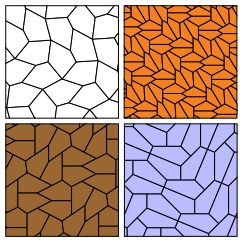
By: Ed Pegg Jr.; David Eppstein; David Dailey
Fast forward some decades to 2017 and Thomas Royen, a retired professor of statistics at a small local university, became known for a proof (of the general case) of the Gaussian Correlation Inequality (GCI), a conjecture from the 1950s. His epiphany had actually occurred a few years prior in 2014 while brushing his teeth (!). Because of his background his proof involved techniques most statistics students will at least be familiar, if not comfortable, with (using the Laplace transform of the multivariate gamma distribution), instead of much more complex but more “accepted” approaches rooted in geometry which in hindsight led other mathematicians down unsuccessful paths for this problem. This lack of success by others and the fact that Royen first published his work in a minor academic journal (and online) explain why it took the scientific community a while to take note.
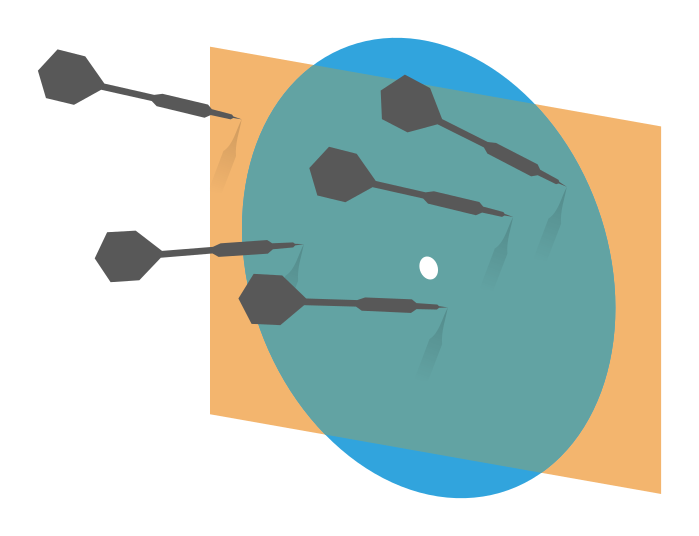
By: Augel – Own work, CC BY-SA 4.0
While one can clearly still make headlines in retirement, some may not want to wait that long. In 2025, and only a teenager at the time, Hannah Mira Cairo caused a scientific sensation for disproving the Mizohata-Takeuchi conjecture (a problem in harmonic analysis), unresolved since the 1980s. Initially home-schooled, Hannah began attending graduate-level mathematics lectures at the University of California, Berkeley, while not yet having finished high school. It was at Berkeley that she started trying to prove the conjecture — piqued by a simplified version of it in a homework assignment — but instead found a counterexample. The conjecture was important because it was connected to questions about wave propagation and how energy distributes itself on curved geometries — a problem that appears in many areas of physics. In Hannah’s counterexample, the wave energy concentrated in a way that violated the conjecture’s bounds.
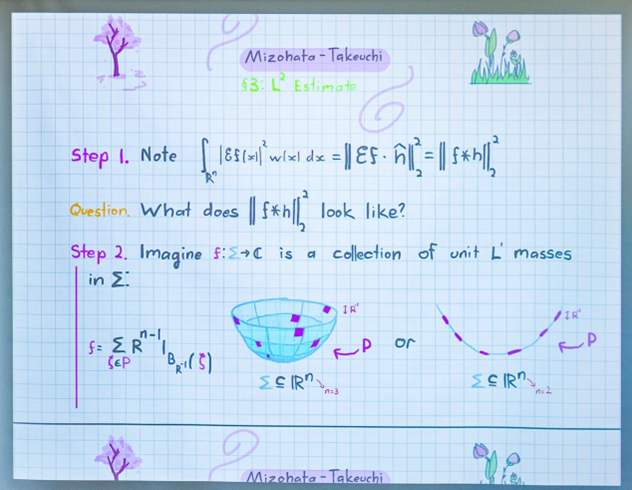
By: Valerie Plesch
Now apparently it is not only humans who can think outside the box. It seems that thinking outside it is possible inside it, too. In May 2026, a model by OpenAI refuted an Erdős conjecture for the Unit Distance Problem: Given n points in the plane, what is the maximum number of pairs of points that are exactly distance 1 apart? The problem was first posed by Paul Erdős in 1946, and some of its fame is due to the simplicity of its statement. Up until OpenAI’s result, it was thought that a rescaled square grid arrangement would maximize the number of such unit-distance pairs. The model (and remarkably this was NOT an AI trained specifically for mathematics) found an infinite family of examples that could do better, and — to quote OpenAI — it did so using “unexpected, sophisticated ideas from algebraic number theory to bear on an elementary geometric question.”
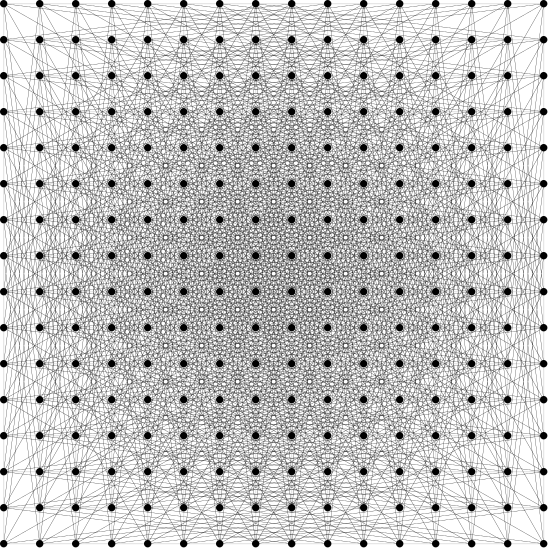
Source: OpenAI
Whether the breakthrough comes from an amateur, a retiree, a teenager, or an AI, the common lesson is perhaps less about genius than about being willing to explore paths others dismissed. Sometimes the next mathematical breakthrough comes not from thinking harder, but from thinking differently.
To end with two famous quotes:
“Do or do not. There is no try.”
Yoda
“Just do it.”
Nike
DISCLOSURE
This presentation includes statements that may constitute forward-looking statements. These statements may be identified by words such as “expects,” “looks forward to,” “anticipates,” “intends,” “plans,” “believes,” “seeks,” “estimates,” “will,” “project” or words of similar meaning. In addition, our representatives may from time to time make oral forward-looking statements. Such statements are based on the current expectations and certain assumptions of Graham Capital Management’s (“GCM”) management, and are, therefore, subject to certain risks and uncertainties. A variety of factors, many of which are beyond GCM’s control, affect the operations, performance, business strategy and results of the accounts that it manages and could cause the actual results, performance or achievements of such accounts to be materially different from any future results, performance or achievements that may be expressed or implied by such forward-looking statements or anticipated on the basis of historical trends.
This document is not a private offering memorandum and does not constitute an offer to sell, nor is it a solicitation of an offer to buy, any security. The views expressed herein are exclusively those of the authors and do not necessarily represent the views of Graham Capital Management. The information contained herein is not intended to provide accounting, legal, or tax advice and should not be relied on for investment decision making.
Tables, charts and commentary contained in this document have been prepared on a best efforts basis by Graham using sources it believes to be reliable although it does not guarantee the accuracy of the information on account of possible errors or omissions in the constituent data or calculations. No part of this document may be divulged to any other person, distributed, resold and/or reproduced without the prior written permission of GCM.
